Green STEAM: Turning Our Environment into a Living Classroom
Updated: 11 hours ago
How can we help young people understand environmental change, develop scientific skills and become active participants in creating a more sustainable future?
This question is at the heart of Green STEAM – Environmental Literacy & Climate Change in Vulnerable Areas, a European educational initiative bringing together schools, a university and educational organisations from seven countries. Supported by the Erasmus+ programme, Green STEAM aims to develop innovative approaches to environmental education by connecting scientific investigation, outdoor learning, digital technologies and creative thinking.
The project is based on a simple principle: students develop a deeper understanding of environmental challenges when they have opportunities to explore their surroundings, ask questions, collect evidence and investigate the world for themselves. Rather than treating sustainability as an abstract concept, Green STEAM encourages teachers to use local environments as starting points for meaningful, interdisciplinary learning experiences.
Learning Beyond the Classroom
Across Europe, young people are growing up in environments affected by climate change, biodiversity loss, changing weather patterns and increasing pressures on natural resources. These challenges are global, but their effects can often be observed and investigated locally. A stream can become an opportunity to study water quality and ecosystem health, a forest can serve as a living laboratory for biodiversity, and a coastal landscape can provide evidence of erosion and environmental change. Even familiar places such as school gardens and playgrounds can offer opportunities to investigate soil conditions, local temperatures, vegetation and sustainable resource use.
Green STEAM builds on these opportunities by promoting place-based education, where students learn through direct engagement with their surroundings. Outdoor activities are combined with scientific observation, environmental monitoring and classroom reflection, helping students connect what they discover locally with wider environmental processes. The objective is not simply to move lessons outdoors, but to make environmental investigation an integral part of everyday teaching, encouraging curiosity, critical thinking and a deeper understanding of the relationships between nature and society.
Explore, Investigate, Reflect, Act
At the centre of Green STEAM is a shared pedagogical framework built around four interconnected stages: Explore – Investigate – Reflect – Act. This approach provides teachers with a practical structure for developing environmental learning activities that combine scientific inquiry, interdisciplinary learning and meaningful student participation.
During the Explore stage, students observe their surroundings, identify environmental features and develop questions they would like to investigate. Investigate introduces scientific methods, fieldwork, environmental sensors and data collection, allowing students to gather evidence and test ideas. Reflect encourages them to analyse their findings, recognise patterns, consider uncertainty and connect local observations with broader environmental challenges. Finally, Act creates opportunities to communicate results, propose improvements, share knowledge or contribute to positive environmental change.
The framework is designed to be flexible and adaptable to different educational settings. A short investigation of temperatures around a school playground might introduce younger students to observation and measurement, while a longer biodiversity monitoring project could involve repeated field visits, digital mapping, data analysis and collaboration with local environmental organisations. In both cases, the emphasis remains on active learning, evidence-based understanding and encouraging students to take responsibility for their own investigations.
Connecting Nature, Science and Technology
Green STEAM combines Science, Technology, Engineering, Arts and Mathematics to help students investigate environmental questions from different perspectives. Environmental challenges rarely belong to a single discipline, and the project encourages teachers to connect scientific understanding with technological skills, mathematical analysis, creativity and communication.
Environmental sensors can be used to measure temperature, humidity, soil moisture, rainfall and other conditions, while digital mapping and observation tools can support biodiversity surveys and environmental monitoring. Students can organise their findings in tables, produce graphs, compare measurements and explore how environmental conditions vary between locations or over time. Creative approaches, including photography, illustration, storytelling and visual communication, can help them interpret and share scientific findings with others.
An important principle of Green STEAM is that technology should support meaningful scientific inquiry rather than become an objective in itself. Effective environmental education does not necessarily require expensive equipment or specialist facilities. Simple observations, basic measuring instruments and carefully designed investigations can provide valuable learning experiences, particularly when students understand how evidence is collected, interpreted and evaluated.
A European Classroom Without Borders
Green STEAM brings together seven partner organisations from Iceland, Ireland, Czechia, Greece, Croatia, Poland and Italy, combining different educational experiences, scientific perspectives and environmental settings. From the volcanic landscapes of Iceland and the river catchments of Ireland to Mediterranean ecosystems, agricultural environments and Central European forests, the partnership offers opportunities to investigate environmental challenges in different geographical and cultural contexts.
Each partner contributes to the development of educational approaches that reflect local conditions while supporting a shared European methodology. Activities being developed include investigations of climate and environmental data, rainfall and flooding, biodiversity mapping, soil health, sustainable land management and traditional ecological knowledge. Although the environmental settings differ, the underlying methods of observation, investigation, data collection and reflection can be adapted and transferred between schools and countries.
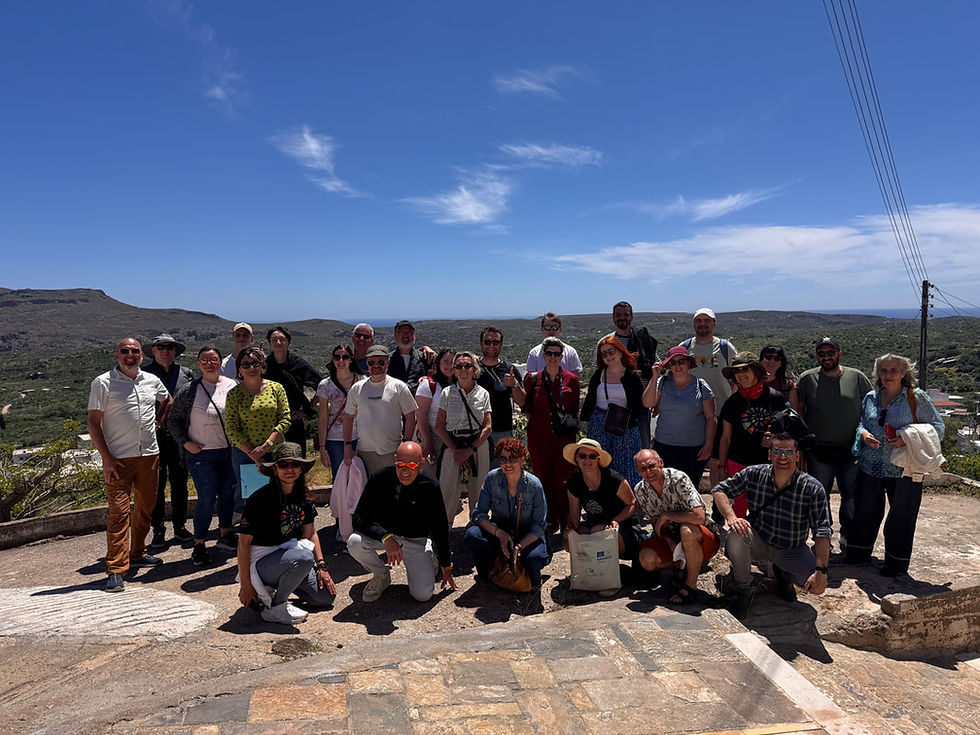
International cooperation is an important part of this process. Through project meetings, teacher training activities and collaborative development, partners exchange experiences, test educational approaches and work towards resources that can be used across different educational systems. Green STEAM also recognises the potential of cooperation between schools, scientific institutions, environmental organisations and UNESCO Global Geoparks, helping connect classroom education with local expertise and real environmental challenges.
Developing Practical Resources for Teachers
A central objective of Green STEAM is to support teachers in integrating environmental literacy, outdoor education and interdisciplinary STEAM learning into their everyday teaching. The partnership is developing a common educational framework, a practical Teacher Handbook, lesson plans, field activity templates and examples of educational practice from participating countries.
The initial working edition of the Green STEAM Teacher Handbook provides guidance on planning outdoor investigations, selecting suitable learning environments, using environmental sensors, interpreting data and assessing student learning. It also addresses practical considerations such as safety, accessibility, equipment, environmental responsibility and adapting activities to different age groups and educational needs. Alongside the handbook, partners are developing lesson plans that demonstrate how local environmental questions can be translated into structured learning activities.
These resources are being developed through collaboration between project partners and will continue to be refined through classroom implementation, field investigations, teacher feedback and international training activities. The aim is to produce practical, adaptable educational materials that remain useful beyond the lifetime of the project and can support teachers working in a wide range of European environments.
From Environmental Awareness to Meaningful Action
Green STEAM is about more than increasing awareness of environmental challenges. The project aims to help young people develop the knowledge, practical skills and confidence needed to investigate environmental questions, evaluate scientific information and participate in discussions about sustainability.
By encouraging students to explore familiar environments, collect and interpret evidence, work across disciplines and communicate their findings, Green STEAM connects environmental education with critical thinking, creativity and active citizenship. The project also demonstrates that meaningful learning opportunities can be found almost everywhere, from school grounds and urban green spaces to forests, rivers, coastlines and protected natural areas.
Ultimately, Green STEAM seeks to contribute to a generation of young people who are not only more aware of environmental challenges, but also better equipped to understand them and consider how they can contribute to a sustainable future.
Because understanding our environment is the first step towards protecting it.
Green STEAM – Environmental Literacy & Climate Change in Vulnerable Areas is an Erasmus+ Cooperation Partnership in School Education (KA220-SCH), coordinated by GeoCamp Iceland. The project runs from September 2025 to February 2028, with a total Erasmus+ grant of €250,000.
Project reference: 2025-1-IS01-KA220-SCH-000365045.


Comments